

Kamilovision is a real-time music visualizer for Mac, iPhone, and iPad. Its worlds have their own motion and atmosphere, with musical reactions that carry you through a track.
Helios Dynamo has been a useful reference point while we refine Kamilovision. A kick or a change in bass can make its star swell and pulse. You can see the musical cue in the reaction, and the reaction belongs to the star.
That is the kind of connection we want throughout the app. Kamilovision turns live audio into visual journeys. The music needs to influence what is happening inside each world, from its smaller movements to its more pronounced moments.
Different worlds give us different ways to do that. Glacier Run carries you forward through ice. Tidal Horizon lets water and changing light set the pace. The Listening Archive puts the response into the lights, books, and atmosphere of a library. Each has its own character, so each needs its own musical language.
Getting the reaction to belong to the world
Much of our recent work has been about making those reactions easier to read. A bass impact might push through water, a light sequence might travel along a train, or a burst of sunlight might originate at the sun. The source, the movement, and the way the effect settles afterward all matter.
The world also has to remain interesting between those moments. Motion, weather, reflections, and smaller responses carry the track while the larger journey unfolds. A scene needs enough continuity for you to stay with it through an entire song.

Fluid motion is a big part of that experience. Water needs movement of its own, with musical energy affecting its behavior. In Tidal Horizon and Mirror Monsoon, the surface and reflections contribute to the atmosphere throughout the track.
This is why we spend time watching the app in motion. A still image tells you something about the composition. It cannot tell you whether a swell feels right, whether travel stays smooth, or whether a musical reaction appears to come from the right place.
Audio capture has needed the same attention. System Audio on a Mac gives the analyzer a direct signal. An iPhone microphone hears speakers, room noise, and the acoustics of the space. We have worked on that microphone path and its sensitivity controls so the musical cues are easier to pick up at ordinary listening volumes.
Rendering on a phone brings another constraint: the visuals need to keep moving smoothly over time. Quality profiles let you choose a balance for the device and display you are using. More detail is useful when the device can sustain it; consistent motion is part of the visual quality too.
Giving you control of the experience
Kamilovision can accompany an album at home or become part of a DJ set. Those uses need different amounts of attention. Sometimes you want to leave the visuals running. Sometimes you want to decide exactly when a world changes.
Adaptive playback can choose and time the next journey from the music. An Ordered Live Set follows your chosen sequence. Hold lets you stay with one world while it continues moving and responding. Pause Session preserves the frame and suspends rendering and audio analysis.
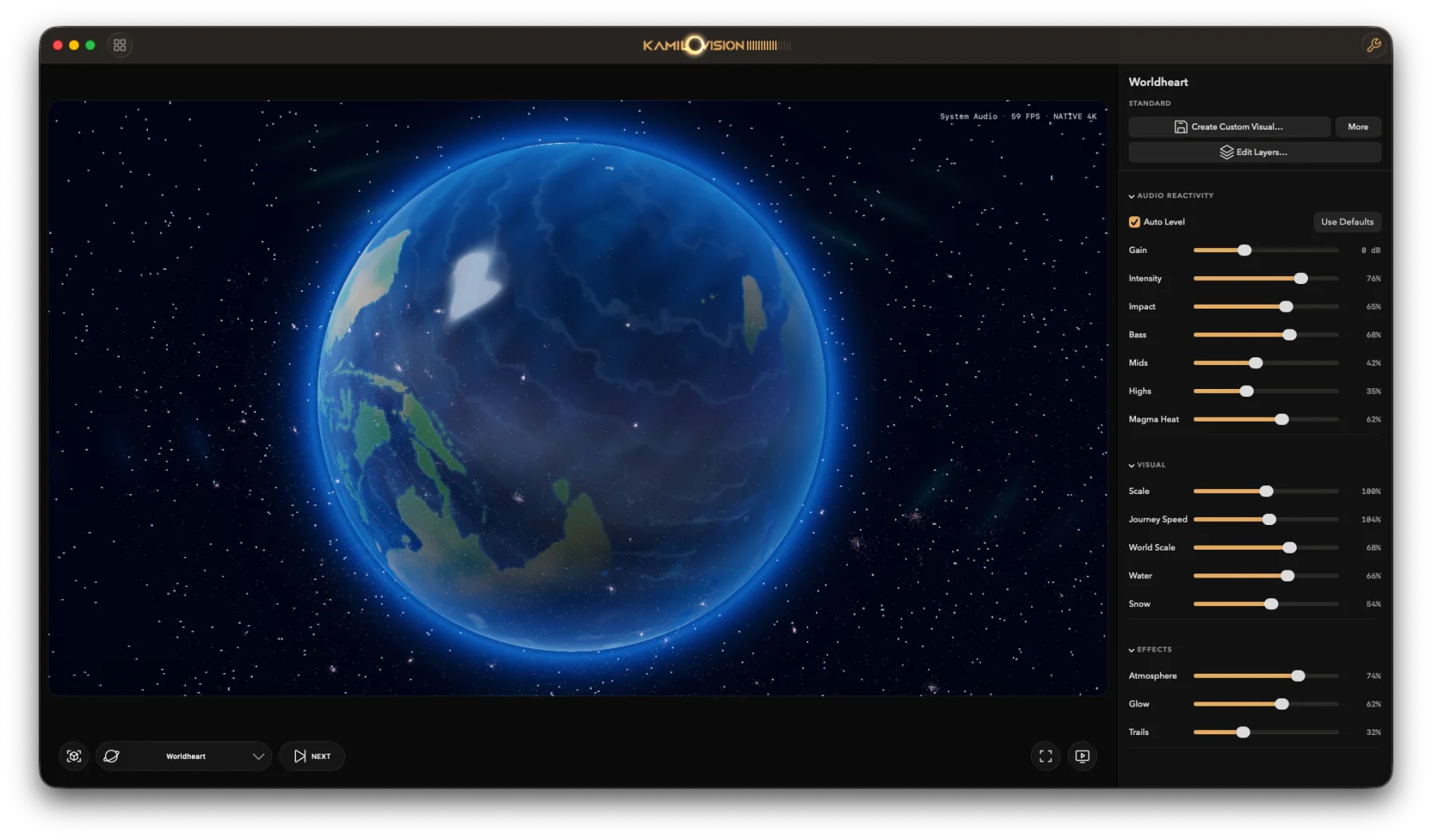
You can tune the response and appearance of a world, save a Custom Visual, and add your own images or GIFs. Those layers can respond to music through movement, scale, rotation, opacity, and playback. This gives you room to make the visual your own while keeping the original available.
On a compatible external display, the audience gets the visual and you keep the controls on your device. That is useful when you want to adjust the set without putting menus over the picture. A compatible wired connection offers the most consistent display delay; AirPlay Screen Mirroring depends on the device, receiver, and network.
Kamilovision runs on Mac, iPhone, and iPad. Mac supports System Audio, microphones, and connected audio devices. On iPhone and iPad, use the microphone or a compatible connected audio input. Audio analysis and rendering happen locally.
We judge the experience by watching it with music for a while. A good reaction catches your attention. The movement and atmosphere need to hold it through the rest of the track.